Louis Faurer American, 1916-2001
Printed by Chuck Kelton, 1980-81.
.
Paper: 35.6 x 27.8 cm / 14 x 11 in
.
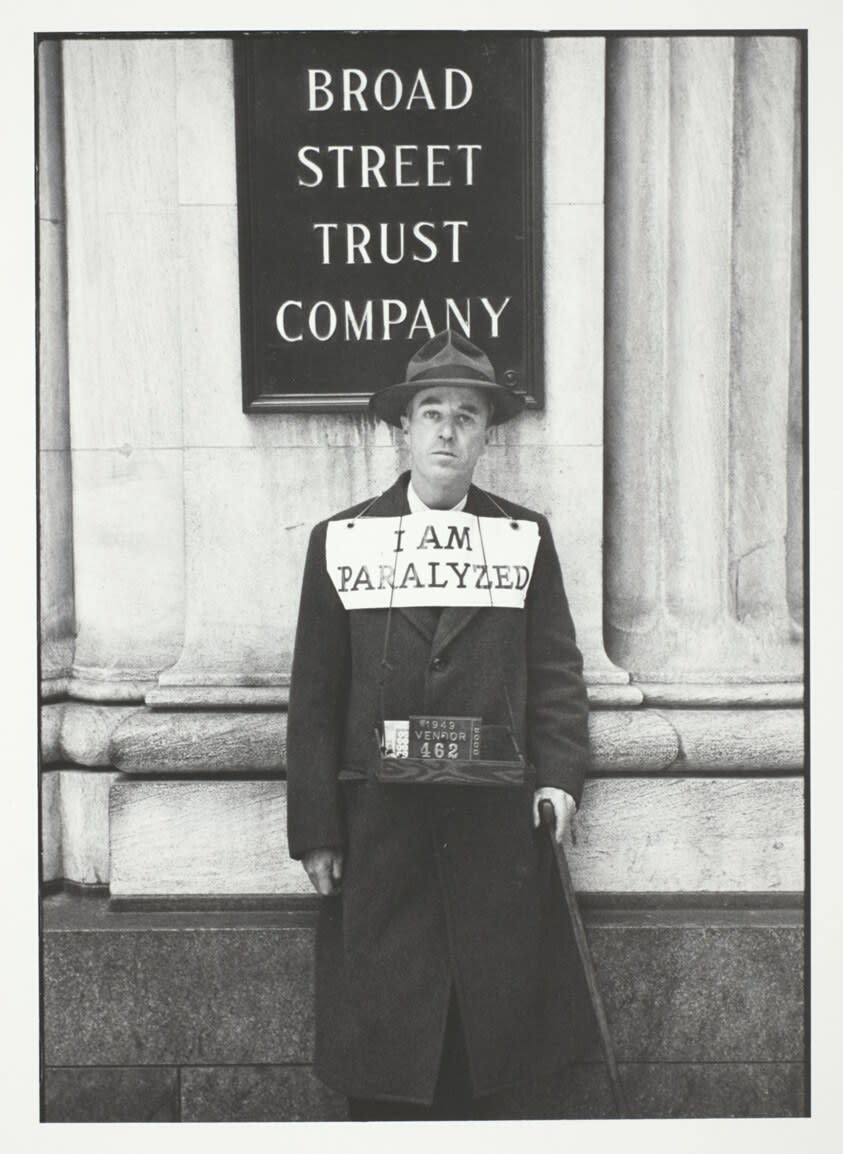
Louis Faurer’s "Untitled, Philadelphia, PA, 1949" stands as an indelible vision of urban vulnerability and perseverance.
In the stark black-and-white frame, a solitary figure stands in front of a bank, a placard across his chest stating “I AM PARALYZED.”
The vendor’s license and cane root this image in the daily struggle of postwar America, restoring dignity to a man forced by circumstance to become a living symbol of hardship.
Faurer’s composition avoids sentimentality and irony, instead opening a quiet dialogue about resilience, invisibility, and the need for recognition in the churn of the modern city.
Faurer was deeply sympathetic to those on the margins and excelled at capturing fleeting moments of introspection amidst the city’s bustle. His photographic technique—embracing grain, blur, deep shadows, and stark contrast—evokes both vulnerability and defiance.
The obscured face of the sitter universalizes his plight; he becomes every person overlooked by society, a parable for the unseen and unheard. Through such images, Faurer reveals a city not just as a space of commerce but as a living stage for private battles.
Faurer’s passion for documenting reality sprang from a profound instinct to record life’s miraculous juxtapositions and psychological undercurrents.
His work, often described as honest and empathetic, resists dramatic gestures in favor of subtle interactions: moments suspended between expectation and resignation. What endures most is the compassion running through his lens, insisting on the worth of every life encountered on the streets.
In "Untitled, Philadelphia, PA, 1949," an otherwise fleeting moment achieves permanence, speaking quietly of dignity, isolation, and the necessity of kindness in a world that often forgets to look twice.