
Carlos Idun-Tawiah Ghanaian, b. 18/5/1997
.
127 x 91.4 cm / 50 x 36 in
.
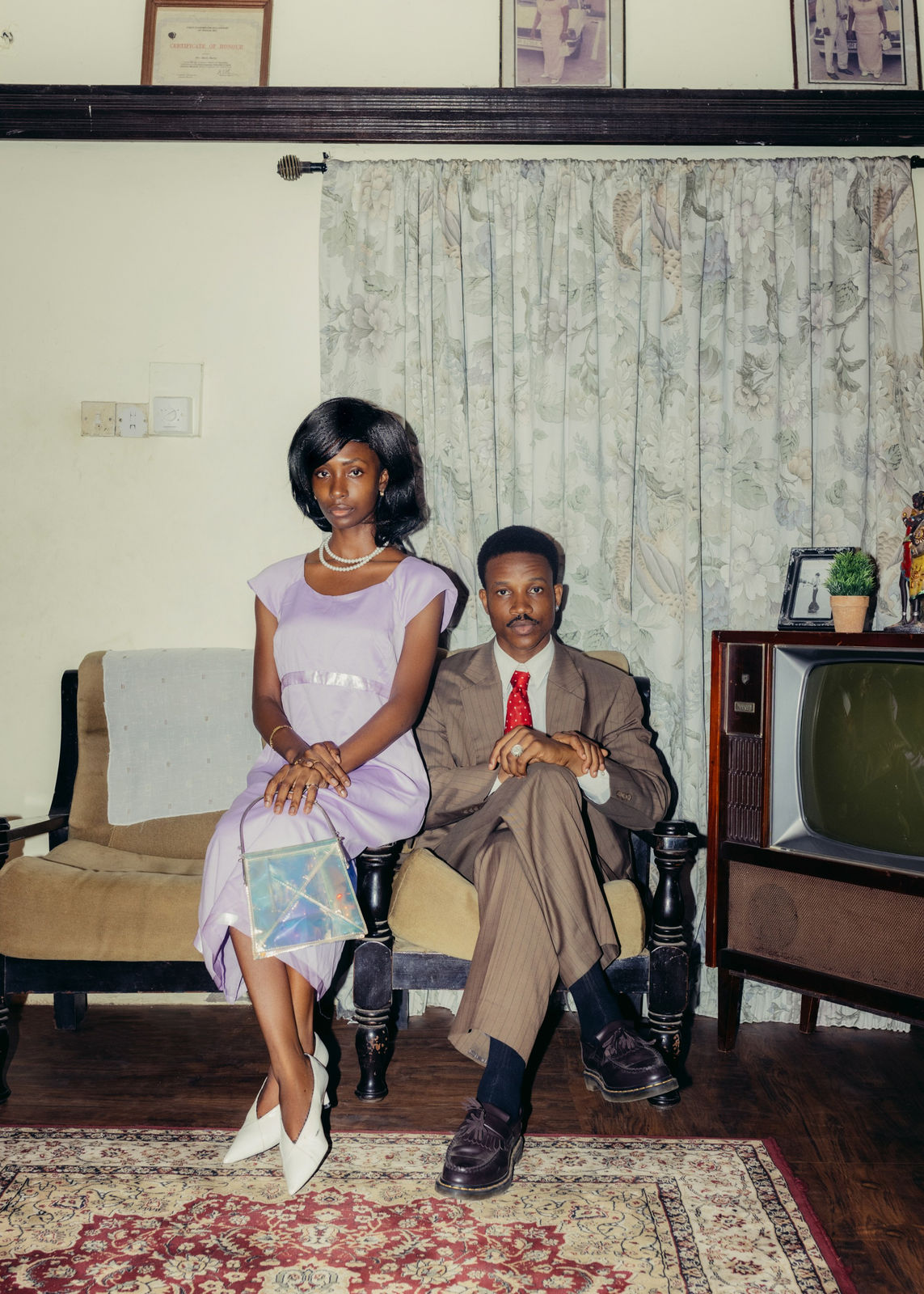
They sit in the glow of a Sunday afternoon, framed by floral curtains and the steady presence of an old television set. Time tightens around them, as if the room were a keepsake carefully returned to its box.
The young woman in lilac, spine straight and ankles crossed, wears composure like a second dress. Her pearl necklace draws a bright curve at her collarbone, while the transparent handbag at her side scatters light like small, private dreams. Beside her, the man in the pinstripe suit and red tie leans forward slightly, hands folded with the assurance of someone who has learned to pose not only for the camera, but for life itself.
This is Daddy’s Polaroid, remade in Accra in 2022, a memory that never fully belonged to the present yet insists on living here. The furniture, carpet, and boxy television murmur of an earlier Ghanaian middle class, when photographs were rare ceremonies and Sunday best was a ritual of dignity. Yet the image reaches beyond nostalgia. Their poses carry too much intention, their gazes too alert. They do not simply reenact a past; they edit it, claiming ownership of the story they inherited.
Sunday becomes a stage where intimacy and performance meet: outfits chosen with care, the room arranged like a set, the camera invited as honored guest. Under the formality lies tenderness, a quiet contract between generations—between the fading grain of Daddy’s original Polaroid and the sharp digital clarity of today. To step into a parent’s frame is to feel their hopes and myths settle over your shoulders like a tailored jacket.
Holding the pose, they hold the past; yet in their unflinching gaze, they ask to be seen not as echoes, but as the authors of what comes next.