
Todd Hido American, b. 1968
.
61 x 50.8 cm / 24 x 20 in
.
Edition of 5 + 1AP
96.5 x 76.2 cm / 38 x 30 in
.
Edition of 3 + 1AP
121.9 x 96.5 cm / 48 x 38 in
.
Edition of 1 + 1 AP NFS
187.3 x 149.9 cm / 73 3/4 x 59 in
.
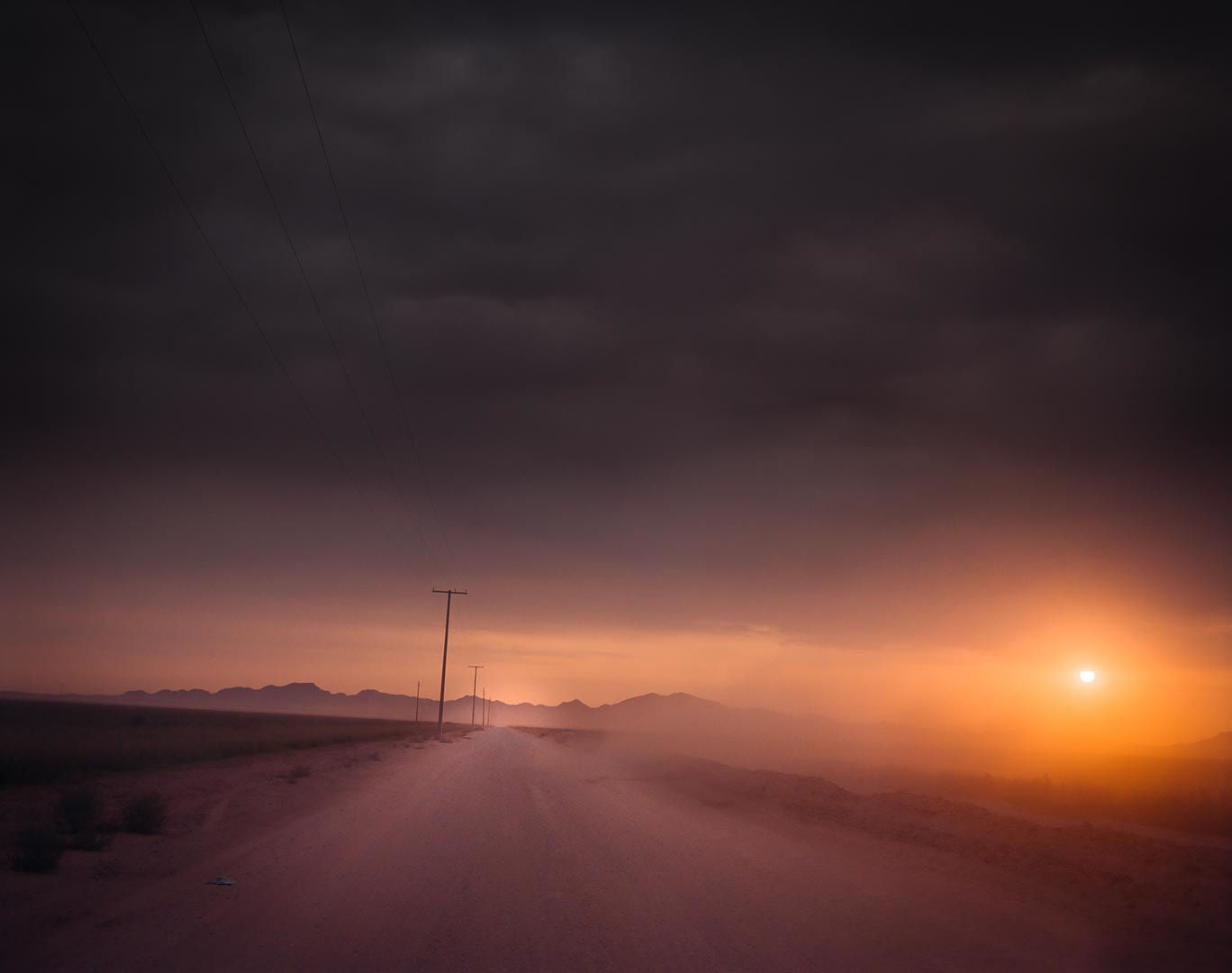
In this haunting landscape, Todd Hido captures the American frontier at that fleeting moment between day and night, where the ordinary becomes transcendent through light and atmosphere. A ribbon of asphalt stretches toward the horizon, flanked by telephone poles that march like sentinels into luminous haze, their geometric precision contrasting the soft dissolution of the landscape. Rendered nearly monochromatic through masterful command of tone, warm amber and ochre bleed into deeper purples above.
What distinguishes Hido's vision is his commitment to capturing the "pregnant moment"—that suspended instant when light and form align to evoke something beyond articulation. The sun, positioned at the horizon's edge like a glowing portal, bathes the scene in warmth that feels simultaneously comforting and profoundly isolating. The atmospheric haze—whether natural fog, dust, or grit collected through his windshield—lends the photograph dreamlike, almost nostalgic quality. Hido deliberately seeks such conditions, understanding that obscurity and softness paradoxically reveal emotional truth more powerfully than clarity.
The solitary road embodies his artistic inquiry: the exploration of American emptiness, the sublime found in desolation, narratives implicit in abandoned geographies. No figures inhabit this space, yet infrastructure hints at untold stories and invisible human currents moving through forgotten spaces. Power lines become symbols of connection and alienation simultaneously, technological intrusions that somehow enhance rather than diminish the scene's poetic resonance.
Shot through the contemplative frame of his automobile—Hido's studio of solitude—this image exemplifies his philosophical approach to landscape photography. Each photograph feels borrowed from memory or dream, infused with cinematic sensibility, yet rooted absolutely in observed reality. It is this balance between the visceral and ethereal, between documentary precision and imaginative reverie, that marks Hido's profound contribution to contemporary visual culture. In the absence of incident, he discovers inexhaustible meaning.